

In 2013 Croatia became the most recent nation to join the European Union as part of the EU’s latest enlargement. Since then, the EU has deliberately decided to slow enlargement to consolidate existing members and reforms within the EU. However, the question of enlargement has re-emerged in recent history with several promising candidate countries. Of these candidates, Montenegro has emerged as the likely frontrunner to become the next EU member state, with other candidates such as Albania, Moldova and Ukraine following. This article will discuss how close each of the applicable candidate and some non-candidate countries are in realising membership, as well as giving an overview of the reforms that must take place first before significant EU enlargement can become politically viable.
To understand why EU enlargement has stalled since 2013, you must begin with Jean-Claude Juncker who took over the European Commission in 2014. He stated that no new members would join the EU during his five-year mandate (2014-2019) due to the belief that no candidate country, especially in the Western Balkans, would be able to meet the entry criteria by 2019. However, this sentiment also represents the significant enlargement fatigue post-2013, the eurozone crisis, migrant crisis and Brexit. Simply put, these crises had to be properly resolved by the EU first before the question of future EU enlargement could be addressed. Furthermore, there is also a strong belief that the EU must first consolidate its decision-making process by reforming the unanimous voting process into a system of qualified majority voting (QMV) for sensitive areas such as the Common Foreign and Security Policy (CFSP) or EU-wide taxation. The Council already uses QMV for the majority of policy areas and expanding this to the CFSP would allow for quicker decision making and would avoid paralysis in an instance where there is a single outlier (such as Hungary under Orbán). Current criteria require 55% of member states (15/27), which represent at least 65% of the total EU population, to vote in favour.
The main EU members in favour of QMV reform are the aptly named Group of Friends on Qualified Majority Voting. This is a group founded in May 2023 in response to Hungarian holds on Russian sanctions packages. Current members consist of Belgium, Denmark, Finland, France, Germany, Italy, Luxembourg, Netherlands, Romania, Slovenia, Spain, Sweden. Several EU members remain firmly opposed to implementing QMV decision-making, with the biggest opponents being Hungary, Greece and Cyprus. Hungary was the most prolific user of the veto under Orbán. Magyar’s Tisza is seeking to reset EU relations to unlock EUR 16.7 billion in frozen funding (read my previous post for a full analysis) but has maintained the position that Hungary will use its veto to protect its interests, albeit avoiding the previous “political theatre”. Cyprus blocked Turkey from the EU’s SAFE defence procurement programme in October 2025, with Greece backing the position, and famously also vetoed a widely-accepted sanctions package against Belarus following the controversy of the 2020 election, citing EU inaction over Turkish seismic surveys conducted in waters claimed by Greece and Cyprus. As a result, the EU issued a strong statement in support of Cyprus and Greece, and threatened punitive measures against Turkey if work continued. Proponents of QMV cite this example as a case for QMV implementation, due to Cyprus leveraging its veto to hold up an uncontested sanctions package. Cyprus views this same episode as a case that unanimity works; it forced the EU to take its concerns seriously when they otherwise may not have. These individual examples suggest that whilst small EU-member states are able to escalate bilateral disputes to an EU-level, they will be extremely hesitant to give up this ability. As such, large-scale expansions, similar to the 2004 expansion where 10 countries joined at once, will likely not be seen again. Instead, each applicant will proceed with their accession individually.
Now let’s have a look at the likelihood of each potential member joining the EU as things are.
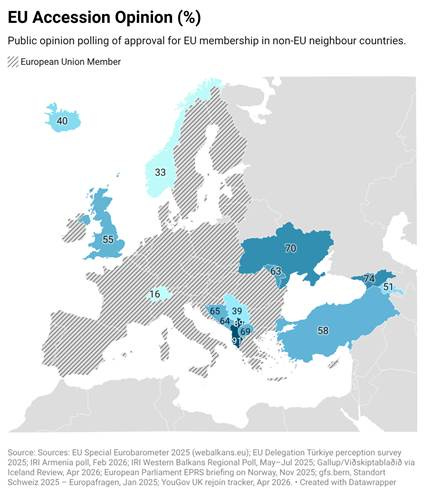
A 2025 Eurobarometer study found that 56% of EU citizens are in favour of future EU enlargement, and there are currently nine official candidate countries: Albania, Bosnia and Herzegovina, Georgia, Moldova, Montenegro, North Macedonia, Serbia, Turkey and Ukraine. However, as Turkey’s accession negotiations have been at a standstill since 2018, Georgia’s government has halted the EU accession processes until 2028 and Bosnia and Herzegovina is significantly restricted by internal political dysfunction, they will be excluded from this analysis. Iceland and the UK will also be included as Iceland approaches a referendum on membership and the UK reassesses 10 years on from the Brexit vote.
Montenegro:
Montenegro has emerged as the natural frontrunner in the race for EU membership. Recent momentum stems from the 2024 Interim Benchmark Assessment Report (IBAR) which found that Montenegro successfully implemented reform for Chapters 23 (judiciary and fundamental rights) and 24 (justice, freedom and security), the procedural gate that unlocked the closure of all other chapters. It has now closed 14 of the 33 chapters and is targeting accession for 2028, as seen with their 28 by 28 campaign. This target is plausible, but any delay may see it being pushed to 2029. The country became a candidate in 2010, and began accession negotiations in 2012. In April 2026 a working group was formed and now its accession treaty will be drafted under the Cyprus Council presidency – a process that will span successive presidencies through 2027. This treaty may include stricter terms and conditions, to account for any potential democratic backsliding so that no ‘Hungary 2.0’ situation arises. The precise mechanics to enforce this are still being negotiated, but early proposals include a rule-of-law conditionality for funding, reversibility clauses allowing membership benefits to be paused or rolled back post-accession and restrictions on council voting rights during the transitional period. Spajić has explicitly opposed membership without full voting rights. If the enforcement of these safeguards requires unanimity, then there is a high chance that they would become largely symbolic. A QMV or proposed reverse-QMV system, whereby Commission-proposed sanctions take effect unless blocked by a qualified majority, would address this to avoid the veto-style political deadlock previously discussed. Whatever system of enforcement measures is decided for Montenegro will likely also set the standard for future members, regardless of their size.
Legislative reform will need to continue to be passed rapidly in order to provisionally close the remaining 19 chapters and qualify for EU membership. Assuming that all chapters are closed in time, there is still the process of ratifying the Accession Treaty, which in itself can take 6-18 months. For the EU, Montenegrin accession should be an easy decision. The country is a small, pro-EU, NATO member that is geographically continuous and already uses the euro. Precisely because of this, it is a test-case for the incoming round of EU enlargement, and any seemingly unjust delay from Brussels could damage EU credibility with the other applicants. If Montenegro delivers reform but Brussels does not deliver membership then the signal sent to other candidates is that membership is not conditional on reform delivery after all.
Albania:
Albania has become the second strongest candidate for EU membership, behind only Montenegro. The EU decoupled Albania’s application from North Macedonia’s in 2024, allowing Albania to advance at an unprecedented rate – opening all six negotiation clusters in 13 months. No chapters have yet been closed, but this is because Albania is still awaiting a positive IBAR regarding Chapters 23 and 24. This is expected by late 2026 at the earliest. Albania has the highest public approval of EU accession out of any candidate, at 91% according to the September 2025 Eurobarometer survey. Albanian Prime Minister Edi Rama has called for a 2030 accession date, which is plausible if there are no undue delays, although a 2031 accession date may be more likely. This is due to concern that administrative capacity and the depth of rule-of-law reforms may slow chapter closures.
Ukraine:
Although Ukraine is the strategic priority for the EU, it must still adhere to accession procedure. Ukraine applied for EU membership on 28 February 2022, days after the start of the war with Russia, with formal negotiations beginning in 2024. It has already made progress, including: reforming its justice system, developing a functioning market economy, tackling money laundering, modernising public administration and protecting national minorities. Zelenskyy has made an especially ambitious goal of joining the EU by 2027, the closest date on this list. However, no clusters have been formally opened so far (although the Danish Presidency in 2025 gave Ukraine technical access to begin working on three clusters). This is largely due to Orbán blocking the opening of the first cluster for Ukraine, citing issues of Hungarian minority rights in Ukraine. Magyar has already signalled some openness to working with Ukraine, although he maintained the issue of Hungarian minorities in Transcarpathia. The EU has made it a requirement for Ukraine to implement a plan to protect these minority Hungarians, Poles, Bulgarians and Romanians in Ukraine. Assuming that the Hungarian veto will be lifted by Magyar and Ukraine can begin closing chapters, the 2027 target is still especially ambitious. The war is the primary issue, and although it doesn’t legally block the EU from granting Ukraine membership under Article 49, it would be politically unpalatable for several members. It would also introduce a series of legal challenges for Ukraine, such as CFSP alignment, territorial scope and mutual defence implications under Article 42(7). Whilst this is not a NATO Article 5 equivalent, it would create an “obligation of aid and assistance by all the means in their power” for each of the EU27, which they have not collectively committed to. This introduces the question of whether it is desirable to let Ukraine join in these circumstances at all. Diplomatic circles have instead suggested that the current time target is not credible, and that a 2028-2030 range is the earliest conceivable date. German Chancellor Merz suggested that 2027 or even 2028 is not realistic. Germany and France instead proposed a system of Associate Membership, interim EU membership without voting rights. Zelenskyy has already rejected this proposal, instead calling for full membership. As such, it is likely that Ukraine may be delayed until the 2030s for full membership.
Moldova:
Moldova applied for EU membership shortly after Ukraine did, in March 2022. Both applications became coupled together when they were granted candidate status together in June 2022. Negotiations opened in June 2024, but since then no clusters have formally been opened. This is because Hungary’s veto on Ukraine’s cluster openings also blocked Moldova since the Council has treated the two as a package. There has been some debate about decoupling Moldova’s application from Ukraine, as there are no disagreements between the EU27 and Moldova, but this proposal has been rejected so far. Nevertheless, Moldova has worked to make gains towards EU membership, with the pro-EU PAS party winning an outright majority in the 2025 elections – despite extensive Russian interference. The EU has also approved the Moldova growth plan, a EUR 1.9 billion investment of grants and loans into Moldova to enhance investment into the country following reform success. This is the most significant pre-accession financial commitment of any candidate. The most significant issue is Transnistria, a Russia-aligned breakaway region. The reintegration of Transnistria into Moldova would be the preferred outcome for Brussels, to avoid an instance where the contested territory is excluded from EU membership. Regardless, Moldova has made significant strides towards EU standards, especially in terms of its democracy. Initial time targets for EU membership are 2028, but this is again dependent on Magyar dropping the Hungarian veto, the situation in Ukraine and any other delays. A 2029-2030 accession date may be more likely.
North Macedonia:
North Macedonia finds itself in the unique situation where its own accession to the EU is not especially related to its own shortcomings. It has already changed its name in 2019 to settle a dispute with Greece, joined NATO and delivered reforms since it became a candidate in 2005. Not a single chapter has been opened in the two decades since. The delay traces back to the now-resolved Greek veto and the ongoing Bulgarian veto. Bulgaria has demanded that the Bulgarian community be included as a constitutive minority in the Macedonian constitution and be given additional protections. Alongside this, Bulgaria has also accused North Macedonia of misrepresenting their shared history, and urges additional educational reform and has moved to extend conditions further to historical and linguistic questions. North Macedonia has been hesitant to commit to this without a guarantee that Bulgaria will then drop its veto without issuing further demands. Macedonian Prime Minister Hristijan Mickoski has refused to amend the constitution to include Bulgarians as a constitutive minority, pledging that there would be no constitutional changes during his term. Unless North Macedonia concedes this change, or Brussels moves to pressure Bulgaria to drop its veto, there is no foreseeable path to opening negotiations.
Serbia:
Whilst the Serbian accession process is formally underway, it is practically stalled by Vučić. Accession negotiations began in 2014 and 22 chapters have been opened, but only 2 provisionally closed. No chapters have been opened or closed since December 2021. Vučić suggested in May 2026 that Serbia could become an EU member by 2028, but this will not happen. Structural issues include democratic backsliding, concerns about media freedom, disagreements with the EU about Russian sanctions and the Kosovo question. IRI polling also suggests that only 39% would vote for EU membership in a referendum. Serbian society has become increasingly polarised and reforms have slowed since the November 2024 protest movement that has escalated in recent weeks. These protests began in response to the 2024 Novi Sad canopy collapse which killed 16 people, a tragedy blamed on issues of corruption and state negligence towards infrastructure projects. Vučić has now made concessions to the student protestors that there will be parliamentary elections at the end of the year, and that he will not contest the presidential election citing constitutional limits. The Serbian opposition is genuinely fragmented, and the protestor-led pro-EU Student List is the most popular but least organised of them. Early polling suggested that the Student List could even beat Vučić’s SNS. We would need to see how the protests are resolved and who wins the incoming election before concluding Serbia’s accession timetable, but it seems clear that a SNS victory would extend the freeze of accession negotiations, whilst an opposition victory may restart it. Either way, serious structural barriers remain.
The United Kingdom:
The UK famously became the first member to leave the EU under Article 50 as a result of their 2016 Brexit referendum, where 51.89% voted in favour of leaving. Almost 10 years later, the public opinion has shifted in favour of rejoining the EU, with a 2025 YouGov poll recording 55% in favour (although this drops to 36% in a scenario where the euro and Schengen must both be adopted). Whilst the current government under Starmer has ruled out rejoining the EU, it has sought out several measures to reset relations. This was realised in the May 2025 EU-UK summit, where the EU and UK underlined shared values, and agreed a new strategic partnership, security and defence partnership, UK access to SAFE and a possibility for closer cooperation under the Common Understanding agreement, which includes a UK return to ERASMUS+ and a potential youth mobility scheme, among more. Unlike the other candidates in this piece, the UK is not an EU applicant or candidate. A serious movement to rejoin would technically be faster due to the UK’s previous familiarity with the EU, although the UK may not be granted previous opt-outs, and may therefore be required to accept the euro and Schengen under Article 49.
Starmer is experiencing a severe leadership crisis with nearly 100 Labour MPs calling for his resignation following their catastrophic local election results, which introduces the debate as to who could replace him. The favourite is Andy Burnham, the popular Mayor of Manchester who is seeking election as an MP in the Makerfield by-election on 18 June. Polls suggest that he would win a potential Labour leadership election, although he must first win his seat in the by-election, which is contested with Reform. Burnham has stated that whilst he hopes that the UK will return to the EU in his lifetime, he would not pursue it as Prime Minister. This is likely due to the growing influence of Reform in politics, who have emerged as Labour’s most significant opponent and are running on anti-immigration policies. The salience of Reform’s anti-migrant rhetoric draws on the same political coalition as the previous Brexit referendum, which therefore discourages many of the pro-EU Labour members from taking the membership question more seriously as it has become politically unviable. Other potential Labour leadership contenders, such as Wes Streeting, have called for the UK to rejoin the EU. However, May 2026 polling suggests that he would lose decisively to Starmer, so there is no strong prospect of him winning a future leadership election. Either way, debate over EU membership is promising for deeper UK-EU cooperation in the future, even if it is not seriously pursued yet.
Iceland:
Iceland is the dark horse in the question of EU membership. The nation is set to have a referendum on EU membership on 29 August 2026 on whether to resume negotiations by 2027, after asking in 2015 to no longer be considered an applicant. For context, Iceland had opened 27 chapters and provisionally closed 11 before withdrawing. Initial polls suggest that the majority of respondents would vote against resuming negotiations, with 47% voting against compared to 40% voting for. Trump’s hostility against Greenland has pushed Iceland to reconsider membership in the face of geopolitical uncertainty. Inflation reaching 5.4% in March 2026 has also emerged as a key consideration for the referendum; the euro would offer more stability than the krona. Iceland is already highly qualified to join as an EEA member, NATO member with Schengen Associate status and one of the strongest democracies and GDP-per capita ratings in the world. The historical barrier to Icelandic membership has been a disagreement regarding the Common Fisheries Policy. For Iceland, this is an issue of sovereignty, and was one of the primary reasons for negotiations collapsing in 2013. The EU has proposed some flexibility here, which may help to resolve the long-standing issue. If Iceland votes yes then it is possible that we may see Iceland joining the EU as soon as 2028 – according to Iceland’s Foreign Minister Þorgerður Katrín Gunnarsdóttir. If they vote no then the question of membership will be closed for another generation.
The EU is soon approaching a new period of enlargement, but the accession framework is being rewritten in real time. Montenegro is the most likely country to obtain EU membership, due to its advanced position in the process. It has become the test case for whether Brussels can deliver EU enlargement, after over a decade of significant caution post-2013, with the conditions of Montenegro’s membership likely acting as a template for the other candidates. The EU continues to debate QMV regulations, rule-of-law conditionality and potential Associate Status for the countries seeking EU accession. Montenegro, Albania, Ukraine and Moldova are all expected to complete their accession processes in the near future, whilst North Macedonia and Serbia are frozen in the process. The UK and Iceland have the potential to emerge as surprise candidates, although this is far more likely for Iceland as the UK is unlikely to reapply this decade. The deeper story is that institutional reform and EU enlargement are no longer separable. The existing unanimity approach is structurally incompatible with the total enlargement workload, which risks slowing enlargement beyond the publicly outlined timeframes.
If this article was valuable to you, please consider supporting me here or by becoming a paid subscriber. You can also follow this page on Instagram here.
In my opinion Armenia will be the next eu member state. The latest eu summit showed us this. It was a summit with real symbolic weight! Since Russia failed to intervene in September 2023, Azerbaijan retook Nagorno-Karabakh. This resulted in Armenia seeking stronger, more reliable partners. Yet Armenia is also a great opportunity for the EU; it sits at an intersection of three spheres of power: the EU, Russia, and Iran. Because of that geography, multiple critical trade routes run through it. These routes are of High importance, such as the Trans-Caspian Middle Corridor (important for China), the North-South Corridor, and the Meghri Special Economic Zone (important for Iran). Therefore, this is not a diplomatic gesture. It is logistical positioning around three corridors at once. Another important symbol is Carney showing up in Yerevan. When 34 democracies organize themselves around a country that was in another orbit three years ago, the message is that the open society model still has gravitational pull, even when populism is loud.
That said, the next Armenian election will be decisive. Some reports suggest Russia is attempting to relocate up to 100,000 Armenian nationals from Russia back to Armenia ahead of the vote, with the apparent goal of swinging the result toward pro-Russian candidates. If true, this would be a direct attempt to manipulate Armenia’s democratic process. The EU must therefore not only offer Armenia a European perspective, but actively support the integrity of its electoral institutions. A free and fair election in Yerevan may matter as much to Europe’s future as any summit.
The enlargement of the European Union is a crucial and complex process within the broader context of the redefinition of international geopolitical balances. The most recent official accession, that of Croatia in 2013, marked an important, albeit inconclusive, milestone in the ongoing process of European expansion. This process continues to influence power dynamics in the region and beyond.
Each new accession requires a re-evaluation of Europe's political, economic and security landscape. Geopolitically, integrating new members means extending common rules and policies, but also addressing new challenges related to socioeconomic differences, bilateral relations with other powers, and potential internal imbalances within the Union.
From an international order perspective, EU enlargement can be seen as strengthening a multilateral cooperation model based on shared rules. However, this dynamic occurs against a global backdrop of growing rivalries, in which European expansion can also be perceived as a source of geopolitical competition, particularly by those who view European influence as a constraint on their own interests.
Therefore, analysing who the next EU member will be also means considering the broader implications, such as regional stability, relations with Russia and other neighbouring countries, managing migration flows and socio-economic transformations within the Union. Enlargement is not merely a matter of territorial policy, but an event that reflects and helps shape the European and global geopolitical order.
Discussions on these issues can benefit from the insights and analysis provided by projects such as the 'Ordine Zero' editorial initiative and the 'Coordinate' podcast, which adopt a multidisciplinary approach to analyse geopolitical developments without promotional bias.