

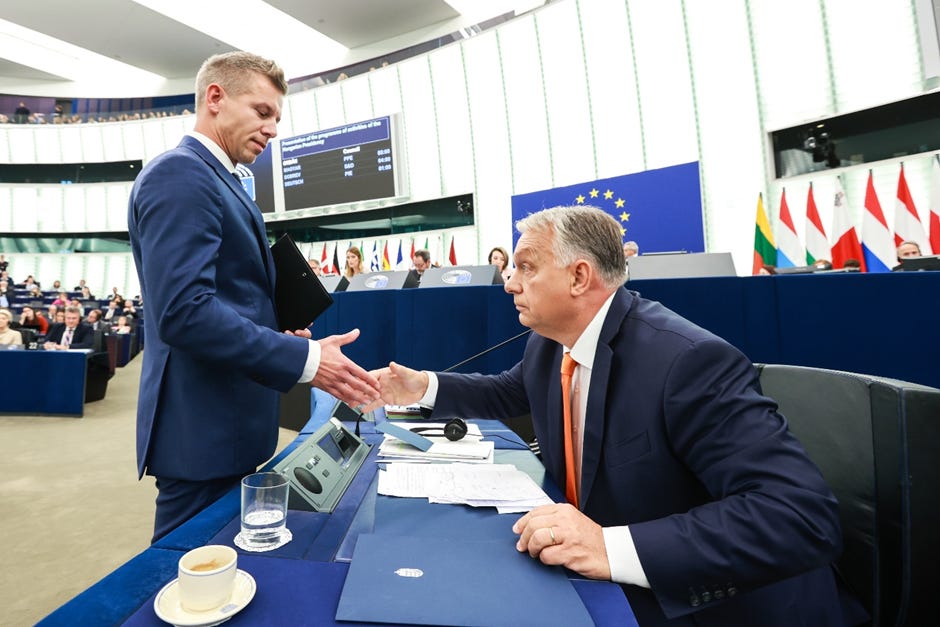
On 12 April Viktor Orbán’s Fidesz party suffered a significant defeat in Hungary’s general election, resulting in the opposition Tisza party winning a supermajority with 141/199 seats. This marks one of the European Union’s most consequential elections in recent history as Orbán loses power to a pro-EU challenger after 16 years in office. Péter Magyar, the incoming Hungarian Prime Minister, ran on issues of anti-corruption, economic reform, democracy and repairing relationships with Brussels. The last point is the most important here, and it is the reason why so many people across the world were watching the election in Budapest. Brussels is especially keen to reset this relationship, and to bring Hungary back into alignment with the voting patterns of the other EU26 countries. Under Orbán, Hungary has exercised its veto to become the sole dissenting vote or the effective sole blocker of 21 European Council decisions – with the most significant opposition centred around aid to Ukraine and Ukrainian accession, as well as Russian sanctions. Magyar is now tasked with reforming Hungary in time to receive EUR 16.7 billion of frozen funding by the end of the summer.
Much of the initial post-electoral focus was on the Hungarian veto of the EU’s EUR 90 billion loan for Ukraine, as well as the 20th sanctions package for Russia. Magyar quickly spoke in favour of passing these, although it was Orban’s government who dropped their technical vetoes to allow both to pass. This follows the reopening of the Druzhba Pipeline on 21-22 April, which supplies Hungary and Slovakia with Russian oil via Ukraine. As a result, both measures were passed. The loan to Ukraine features EUR 30 billion for macroeconomic support and EUR 60 billion for industrial defence investments. The 20th sanctions package is arguably the most consequential package in the last two years, delivering 120 new individual listings and key economic sanctions surrounding the Russian energy sector and shadow fleet. Additionally, a new anti-circumvention tool which bans certain key EU exports to Kyrgyzstan (as to not be imported to Russia from there) has been introduced.
Although Magyar did not overturn the veto himself, his suggestions that he would do so are still promising for the broader Hungary-EU relations reset. Magyar will not be sworn in until 9 May (Europe Day), but the EU has already sent a delegation to meet with him. Ursula von der Leyen’s Chief of Staff Björn Seibert met with Magyar’s team on 17-18 April to discuss the now-resolved Ukrainian loan/Russian sanctions package and the timeline for how Hungary can move forward to unlock EU funds earmarked for Hungary that have been frozen due to corruption and rule of law concerns. Notably, Tisza and the European Commission have quietly confirmed that the frozen fund release is not linked to sanctions cooperation, a measure designed to push Hungary for quick political reform. For Magyar, the timing is tighter than it looks. He has approximately 130 days between his swearing in and the 31 August Recovery and Resilience Fund (RRF) deadline. This deadline is very unlikely to be extended, and must be met in order to secure the EUR 16.7 billion which has been earmarked for Hungary, split across cohesion funds (EUR 6.3 billion) and RRF funds (EUR 10.4 billion). In order to realise this money, which would account for approximately 8% of Hungary’s GDP, the country must hit 27 super-milestones, which consist of anti-corruption reform, the restoration of the rule of law, media freedom and restoring fundamental rights.
Magyar has so far named ten of his planned sixteen ministers, whilst also demanding that several of the key Orbán era office holders resign by 31 May or face removal via the supermajority. It is vital that Magyar moves quickly to remove Fidesz influence in order to push for the necessary political reforms to unlock the frozen EU funding by the 31 August deadline. Notably, András Kármán, Tisza’s lead figure on financial policy has remarked that the conditions for Hungary to join the Eurozone could likely be created by 2030, following an assessment of the state of Hungary’s public finances. Kármán also spoke about the economic benefit of the euro’s adoption for Hungary, given the country’s deep integration within the euro area economy.
Restoring the rule of law to a strong level will be one of the most effective ways to demonstrate that Hungary is aligning itself with the EU, in order to end the Article 7(1) procedure against Hungary and to help secure the EUR 16.7 billion in frozen funding. Magyar has stressed this point by stating that Hungary will reverse Orbán’s decision to leave the International Criminal Court (ICC) in 2025 – a move that broke with the common EU position on the ICC and the Rome Statute, which all EU members have ratified. Orbán’s government refused to arrest Netanyahu on his visit in 2025, an ICC requirement. This is a move that Magyar has promised not to repeat. On 21 April, the Court of Justice of the European Union (CJEU) has also found that Hungary infringed on Article 2 of the Treaty on the European Union, the first country to ever do so, with its 2021 Child Protection Act as this was found to have stigmatised against LGBTQ communities. 16 EU countries (Including Germany, France, Spain and the Netherlands) and the European Parliament intervened in the case against Hungary by backing the legality of the Article 2 hearing – a genuinely historic ruling. Magyar has not publicly committed to repealing the law, despite commentators suggesting that his pro-EU stance is only credible if he does. This silence from Magyar is likely due to the contention of the topic domestically, with Fidesz in opposition ready to push the topic as a culture-war talking point. Other necessary reforms include EPPO accession, whistleblower architecture, judicial appointments and a media law. Magyar is depending on the EU fund release in order to maintain his domestic popularity, but a release of funds that is too sudden risks undermining the momentum needed to bring about these reforms in the first place.
Initial reactions to the Hungarian election were mixed. Russia has quietly accepted that the election is a strategic loss that cannot be reversed. Moscow initially stated that they would be happy to work with Magyar pragmatically, although this quickly devolved into Putin’s spokesperson Peskov calling Hungary an “unfriendly country” (Russia’s standard designation for EU countries since 2022), as Hungary moved to support the latest sanctions package. Moscow’s relationship is with Orbán himself, and as it cannot be easily transferred across to Tisza, it ends with Orbán. As such, Moscow’s reaction is managed disappointment. Their most significant European ally has been lost and they must now depend on leveraging energy supplies to the region. This has already begun with the planned 1 May Russian suspension of Kazakh oil transit via the Druzhba’s northern branch. German authorities have responded by assuring that there will be no disruption to energy security, but the move is seen as retaliation to the latest package of sanctions.
Washington’s response is notably absent. Vice President Vance made a high-profile appearance in Budapest to help support Orbán’s campaign, an unusual deployment for a sitting Vice President. This marks the significance of the Trump- Orbán relationship, and may be why the US has not congratulated Magyar on his victory as the result is seen as a defeat for the MAGA aligned European right. The Trump administration’s focus on Hungary has always been due to Orbán, not due to any structural factors. As such this is will not be transferred to Magyar, or even to Fidesz as an opposition party. A notable point to consider here is the Lukoil waiver which Orbán secured in November 2025. This is an exemption for Hungary to import oil from Lukoil and Rosneft, two sanctioned Russian energy companies. Orbán had claimed that this exemption would be indefinite, but White House sources suggest that this was for a one-year fixed term, expiring November 2026. Since the Trump administration has no attachment to Magyar, it is unlikely that they will move to extend this exemption. The Trump administration continues to move towards a more transactional relationship with European governments, looking to deal with whomever can deliver on US interests. These developments have been especially significant for the European right-wing parties, many of who met in Milan on 18 April as part of the Patriots for Europe rally. Orbán was notably absent, and was not replaced by a Fidesz delegation. American tariffs and the Russia-Ukraine conflict continue to divide the broader right-wing movement, leaving each member to answer to domestic pressures rather than form a coordinated external outlook.
Poland will perhaps be Hungary’s most important ally in Magyar’s quest to restore relations with the EU. He has spoken about a special relationship between Hungary and Poland, which has been seriously tested in recent years. For example, Orbán’s Hungary has given political asylum to two Polish ministers wanted at home. Magyar has already stated that they are not welcome and will not remain in Hungary for long. Both countries celebrate 23 March as the day of Hungarian-Polish Friendship and Magyar has announced that his first international visit will be to Warsaw, likely as a means to urgently repair this relationship. Poland’s Tusk reacted the most enthusiastically of any EU leader, calling Magyar to say “I’m so happy, I think I am even happier than you.” Poland and Hungary have both been struck with Article 7 violations, and Tusk managed to end the Polish Article 7 procedure in May 2024, after 18 months in office. Should Hungary follow the Polish playbook, it is likely that they will also be able to overturn their Article 7 procedure in the years to come.
Slovakia’s Fico reacted the most cautiously. Without Orbán, Fico will become increasingly politically exposed as he can no longer depend on Hungarian cover. Progressive Slovakia is beating Fico’s SMER 20% to 18% in polls, also making Fico more restrained from confrontations as he lacks domestic approval. As a result, it is likely that Slovakia will shift towards greater pragmatism, caution and a less obstructionist posture rather than a full reversal of Eurosceptic policy. Tusk also suggested that “especially after Orban’s defeat, he won’t pose a major problem” for the EU. Magyar and Fico shared a tense call on 21 April, relating to the Beneš Decrees, which expropriated Germans and Hungarians in post-war Czechoslovakia. Fico’s government had moved to tighten legislation around these decrees by making it a criminal offence to question them. Meanwhile, Magyar is moving to secure minority rights for Hungarian-Slovaks by pushing for Slovakia to repeal this legislation. Fico instead remained more focused on energy policy and the Druzhba restart.
Bulgaria’s reaction was bifurcated due to its own election a week later, in which it elected Rumen Radev’s Progressive Bulgaria party. Radev is seen as pro-Russian and has criticised EU sanctions on Russia, instead calling for more constructive dialogue with the Kremlin. As a result, many were quick to compare Radev with Orbán, however it is very unlikely that he will be in any way as significant of a blocker for the EU as Orbán has been. This is due to Radev inheriting a position that is structurally weaker than Orbán’s. He commands a 131-seat simple majority, not a supermajority, and can therefore not control courts, the central bank or the prosecutor’s office in a way that Orbán could. Furthermore, Radev’s Progressive Bulgaria is a very young party, with no established media presence comparable to that of Fidesz. Bulgaria is also the EU’s poorest member, has already adopted the euro and depends financially on the EU for its rearmament, which is funded entirely through SAFE. This makes potential confrontation with Brussels unlikely, especially since Pro-European public opinion sits high at 56% in the country – preventing the use of systematic vetoes that were used by Orbán.
Magyar inherits a reformable Hungary, not a reformed one. The 31 August deadline will be a critical stress test for him to implement significant political reform to unlock the frozen funding held by the EU. Significant rule-of-law reforms are required to reassure the EU of change, but both Brussels and Budapest need this to go well. The November 2026 Lukoil waiver expiry is another key date to watch for, as it is unlikely to be extended if the Trump administration sees little value in Magyar succeeding Orbán.
If this article was valuable to you, please consider supporting me here or by becoming a paid subscriber. You can also follow this page on Instagram here.
"Gentlemen, stop calling this a 'market.' The global financial system is a hippodrome where trillions of dollars have been bet on one lame, sick horse named 'The US Dollar,' using derivatives with 100x leverage.
>
> The SVWORLD 73.5 Standard does not forbid betting. It simply turns on the scoreboard showing the real odds.
>
> It reveals that this 'favorite' is backed by real resources by only 4–6%.
> It reveals that the entire 'tote board' is filled with air (NREF), and any single sneeze will turn all bets into dust.
>
> SDA is not a new currency. It is the only way to exit this hippodrome alive and withdraw your money before the horses collapse and the crowd starts crushing each other.
>
> The choice is simple: either you continue betting on a corpse, or you switch to reality."
Correct