
Ukraine's Culture War

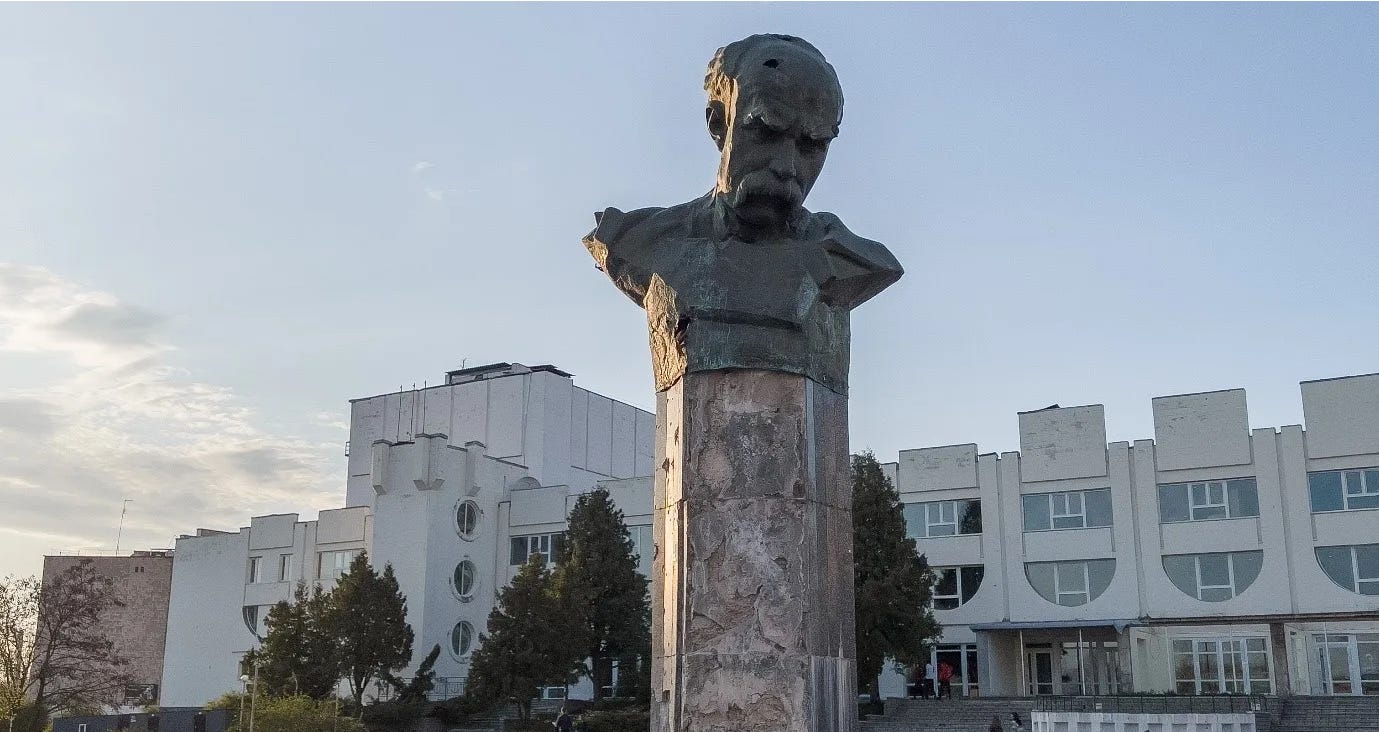
This statue is of Taras Schevchenko – a famous pro-Ukrainian poet - in Borodyanka, Kyiv Region. During the Russian withdrawal from the region the statue was shot through the head, marking a symbolic beginning to the invasion’s underlying culture war. Since the beginning of the Russian Invasion, both sides have begun to turn to cultural identity to justify their stances in the conflict. However, the focus on updating cultural landmarks has come under scrutiny in Ukrainian society as many believe that resources should be focused entirely on the conflict. Despite this, the Ukrainian cultural rebirth has begun, heralding the creation of a society that has left the East-West limbo that has long plagued post-USSR Ukraine.
The Mother Ukraine (formerly known as the Motherland Monument) monument in central Kyiv is perhaps one of the boldest examples of de-communisation that has taken place in Ukraine during the war. The Soviet insignia was replaced by the Ukrainian trident on 6 August 2023, with the approval of some 85% of Ukrainians, according to Ukrainian Culture Ministry. In addition to this, many other Soviet and Russian vestiges have been removed, such as statues and the renaming of streets in favour of Ukrainian figures rather than Russian ones. Ukrainians have also actively begun to prioritise speaking Ukrainian instead of Russian, as a form of cultural expression. Zelenskyy has also suggested that all civil servants are required to learn English as the language of international communication. Such movements will invariably assert Ukraine with the West, and continue to promote collaboration.
Such moves have allowed for decisive policy changes, allowing Ukrainian politicians to leverage public opinion to rapidly engage in economic and security agreements with the west, such as early discussions about joining NATO and the EU. Ukraine’s diplomatic efforts have also allowed the nation to effectively petition Western aid, which has paid dividends. So far, all NATO countries and all EU countries (with the exception of Cyprus, Hungary and Malta) have opted to donate military aid. The EU, and NATO partners have also approved training missions for Ukrainian soldiers, allowing them to optimally use Western weaponry.
In June 2023, the UK hosted the Ukrainian Recovery Conference in London, courting financial support on behalf of Ukraine. The EU has pledged €50 billion, with the UK and US following with $3 billion and $1.3 billion respectively. Whilst this money is far from the total amount needed to rebuild the country, it allows for financial stabilisation, and may not have been possible without the consolidation of Ukrainian culture.
Zelenskyy’s call for aid was answered also by individuals, leading to the creation of numerous foreign legions. Notably, the International Legion which is estimated to consist of 1,000 – 3,000 foreign volunteers. Ukraine has also benefitted from the Polish Volunteer Corps, The Georgian Legion, The Freedom of Russia Legion and The Kastuś Kalinoŭski Regiment. Many of these foreign volunteers are motivated to see their own countries secede from Russian influence, which motivates their ferocity in battle. Pro-Ukrainian Russian and Belarussian volunteers believe that weakening Putin by defending Ukraine is the first step in freeing their own countries and pursuing the Western path that Ukraine has been able to embark on. This is a tangible example of a cultural spill over into Russia and Belarus, which will not be forgotten should the people decide to separate themselves from Putin.
On the flip side, Russia has justified the conflict by their attempt to protect Russian speakers in Eastern Ukraine. Whilst there are many Russian speakers in Eastern Ukraine, this does not mean that the populations are largely pro-Russian, however the Kremlin will not acknowledge this blurred identity and instead works to insert Russian populations in the annexed territories to support their claims. Worryingly, Russia has also been found to have abducted upwards of 19,500 Ukrainian children according to Ukrainian government sources. According to British Officials these child abductions are designed to erase Ukrainian cultural and national identity. Whilst some children have since returned to Ukraine, many are still captive in Russia, perhaps to meet the Kremlin’s objective of reducing the demographic collapse of young Russians following the war with Ukraine. Many of the officials responsible for the abduction and re-education of Ukrainian children have been placed under Western sanctions and have been accused of war crimes, however it is likely that this will continue whilst the war is ongoing.