

.jpg)
Ukraine has maintained its strategy of striking energy infrastructure across Russia, most significantly its oil refineries. Sustained pressure has inflicted significant energy and economic shocks across almost all of Russia; by early July, fuel shortages were reported in 80+ Russian regions. Forty-six of these regions had restricted the amount of fuel that can be purchased and four regions (Penza, Irkutsk, Novosibirsk and Zabaykalsky) had declared states of heightened readiness. In August another wave of shortages occurred as ten regions that had previous relaxed restrictions reimposed them following new supply shortages. On 28 August it was reported by Reuters that Russia is now only meeting 70% of its domestic gasoline supply following Ukrainian drone attacks on its refineries. Russia has already ceased exports of petrol, diesel and jet fuel and has begun to import fuel supplies from Belarus and India to help ease the supply disruption.
Russian oil and gas revenues have now fallen 45.4% year-on-year in Q1 of 2026, although the surging oil price following the US-Iran war helped to alleviate Russian spring revenues. Nevertheless, the federal budget deficit has now reached 6.455 trillion roubles (2.8% of GDP) as of the end of July, far more than the 3.786 trillion deficit expected by Moscow in 2026.
Ukrainian attacks:
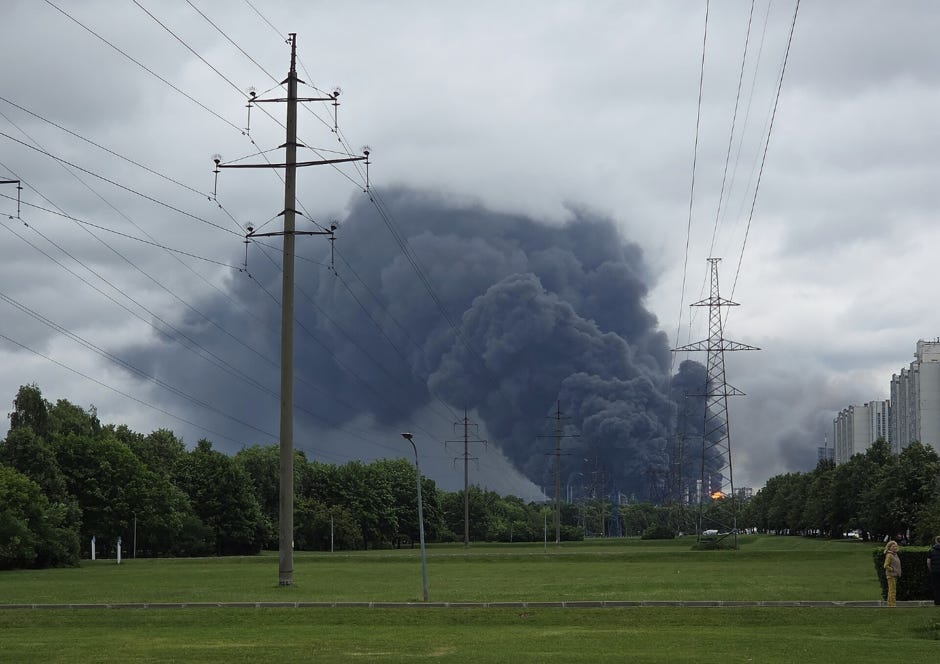
Ukrainian drones have been targeting Russian refineries since 2024; what has changed in 2026 is the intensification and longer reach of this campaign. Reports suggest that at least 24 of Russia’s 34 major refineries were struck in roughly 50 attacks over 100 days. As a result, Russian daily crude processing volumes have dropped to 3.6 million barrels, their lowest level in 24 years, forcing Moscow to ban fuel exports whilst increasing imports to meet domestic demand. This decline reflects Ukraine’s recent efforts to launch high volumes of drone strikes over a dramatically extended range. For example, the strike on Gazprom Neft’s Omsk refinery in western Siberia was approximately 2,500km from the border. The damage inflicted here is also proving to be lasting, as the refinery in Orsk, for example, is expected to be shut down for six months after being hit by a Ukrainian drone. Elsewhere, the Moscow refinery in Kapotnya is not expected to resume production until 2027. Ukraine hit a total of 12 refineries across August, alongside two gas-processing plants and three oil transshipment terminals.
The true impact on Russia’s refinery capacity has not been confirmed, yet Capital Economics suggest that approximately 40% of Russia’s refinery capacity is offline. Ukraine’s General Staff claim 42.7%, whilst Russia has classified this data and therefore does not offer an internal viewpoint. However, Rosstat’s April report has indirectly confirmed that Russian output has been reduced, as they have declared a 9.2% reduction in coke and oil products compared to the previous year. This is the closest estimate that has come from a Russian source due to their classification of data. Russian refiners were estimated to have produced 95,000 tonnes of petrol daily across August, falling below their internal consumption of 115,000 tonnes. Data suggests that petrol prices have risen by 18.4% between January and mid-August as a result. Consumers also face hours-long queues, poorer fuel alternatives and fuel rationing programmes, such as an initiative to alternate who can buy fuel each day based on whether the customer’s number plate ends in an odd or even number. The Russian government have also authorised the production, import and sale of Euro-2, Euro-3 and Euro-4 fuels until July 2027 to help meet demand. Open-source Russian fuel trackers have emerged to help Russians monitor the local availability of fuel in their cities. You can visit Benzinmap or gdebenz to get a better idea of the current situation at the time of reading this article.
The Siege of Crimea:
Nowhere is this fuel scarcity more visible than in Crimea, where Ukraine has effectively placed the peninsula under siege and disrupted the majority of fuel shipments. Fuel prices more than quadrupled over summer, and on 21 June civilian fuel sales were suspended altogether in an effort to reserve supplies for military and state services. Rationed sales have since resumed, but only for four hours per day. Crimean geography is responsible for the severity of the fuel scarcity, as Ukraine is able to exploit logistical vulnerabilities by striking bridges and roads leading into the peninsula. Ukraine’s Unmanned Systems Forces (USF) have prioritised Crimea’s isolation by also targeting oil tankers delivering fuel. On 11 July alone, Ukraine claimed to have struck 21 tankers, forcing Moscow to restrict shipping through the Kerch Strait and Azov-Don Sea Canal. Ukraine has also struck Black Sea port infrastructure in Novorossiysk, the home of a key international oil transshipment complex. The USF have also stated that it aims to destroy the Crimean power grid. Recurring blackouts are now affecting Crimean cities, with major cities reporting significant outages whilst villages in northern Crimea are reporting no electricity for over a month.
France, Belgium, Sweden and the UK have seized nine of Russia’s shadow fleet tankers since January. This is as a result of Russia employing this secondary fleet of aging tankers as a workaround to the G7 sanctions which capped the price of Russian crude oil in December 2022. The EU have blacklisted 673 ships as of July 2026, up from 25 in July 2024, and as a result of the 21st sanctions package member states have the ability to seize and sell cargo found aboard detained tankers, although this has not happened yet and previously intercepted ships were allowed to move on with their crude. Russia has contested the legality of these seizures, suggesting that they border closely on piracy. Putin suggested that Russia would take European ships in return, and has increasingly sent warships to escort their sanctioned commercial vessels.
The Spillover:
One of the less reported but still vital consequences of the Russian fuel crisis is the sudden energy shock for the Central Asian countries that have been historically dependent on Russian fuel exports. The retail price of petrol has increased 15-25% year-on-year from April in dollar terms, across Central Asia, with the fuel shortage arriving just as diesel was needed for the autumn harvest. Kyrgyzstan imports over 90% of its petrol and diesel from Russia, and banned its own fuel exports in July, seeking an alternative supplier from China, Belarus, Kazakhstan and Uzbekistan that has fallen short so far. Russia supplied 91.1% of Tajikistan’s petroleum imports and 95% of Mongolia’s supply – both of which are now facing severe fuel scarcity. Mongolia also briefly implemented a licence plate fuel rationing scheme to alleviate the disrupted supply. Kazakhstan remains a notable exception here thanks to its own fuel refineries; on 25 August the Condensat refinery in western Kazakhstan confirmed that it would begin processing Russian crude and sending 70% of the refined petrol and diesel back to Russia. This scarcity shakes Russia’s long-term strategic position as an energy exporter and will likely dull its ability to use fuel exports as leverage as its neighbours are already seeking out alternative suppliers.
Strikes on Wildberries:
Wildberries, Russia’s equivalent of Amazon, has become a target of Ukrainian drone strikes over the last few months. This is because of its alleged dual-use role, denied by both Wildberries and the Kremlin, whereby Wildberries warehouses act as logistics hubs for both civilian and military equipment – such as drone components or navigational equipment. Ukraine has used this as justification to escalate strikes against its warehouses across Russia in order to disrupt these military logistics, but also to inflict economic damage on Russia. On 22 August, Ukraine’s Defence Ministry stated that Ukraine has now struck Wildberries’ 15 largest hubs. Analysts suggest that 23 warehouses have been damaged or destroyed and that 40% of its warehouse space has been destroyed. These strikes often result in severe fires, destroying the warehouses entirely. As of mid-August, Data Insight estimate these losses to be approximately one-third of their total warehouse capacity, as well as combined financial losses of 600-800 billion roubles (7.2-9.6 billion USD) for Wildberries and its affected sellers. Wildberries have updated their terms to remove liability for stock destroyed by drone, missile and artillery damage, and its founder Tatyana Kim declared the strikes as force majeure – passing the losses onto the sellers directly. This is another key reason why these strikes are generating resentment from the vendors affected. In macro terms, the turnover of Russia’s online retail sector is approximately 5% of GDP. Over 400,000 Russian vendors are affected, with some losing up to 95% of all goods in the warehouse strikes.
Ukraine’s Mykhailo Podolyak has explicitly stated that these attacks are designed to disrupt military supplies, breed popular discontent and stress the Russian banking system. Robert “Magyar” Brovdi, commander of the USF described these efforts as a strategy to disrupt the illusion of a comfortable peacetime that Russian civilians have been allowed to maintain. Wildberries reportedly owes up to 1.3 trillion roubles to Sberbank, VTB, Alfa-Bank and PSB, and this significant destruction of their warehouse capacity and collapse of turnover will make it difficult to repay the debt. Denys Shtilerman, Fire Point‘s co-founder (the company producing the drones carrying out these strikes), claimed that the collapse of Wildberries would lead to the collapse of a number of Russian banks, including VTB, to which it owes more than 500 billion roubles. This announcement that Ukraine is targeting the Russian banking system may itself be a part of the strategy to destabilise the economy and erode trust in the Russian financial system.
Nevertheless, Russian analysts have suggested that whilst significant, these warehouse attacks are unlikely to paralyse the Russian economy at their current scale. However, sustained disruptions would likely further decrease business confidence and subsequent tax revenue. The Association of Digital Platforms (Wildberries, Ozon, Yandex, Avito and Kuper) wrote to Russian Prime Minister Mishustin on 12 August to request a one-off payment from the federal budget to help alleviate losses, whilst other retailers have asked for tax relief measures. On 19 August, Vladimir Putin ordered the Russian government to begin work to help restore the warehouses that have been damaged in Ukrainian drone strikes. On 24 August, Decree 604 was signed, allowing the Russian state the ability to take temporary control of critical infrastructure where the owners have failed to protect it from drones, or have been too slow to repair damage. It was stressed that this is not meant as a nationalisation mechanism, but as a measure to urge reluctant business owners to better prepare for potential drone strikes, and therefore avoid losing control of their assets.
Ozon warehouses have also been targeted, as Ukraine struck a warehouse in Chapayevsk on 22 August, causing Ozon’s share price to fall 27% intraday. Several other Ozon warehouses have been struck since, although it is worth noting that Ozon typically operate smaller warehouses than Wildberries, meaning that individual strikes are comparatively less damaging. Wildberries have also been working to move logistics outside of Russia, by using warehouses in Belarus, Kazakhstan and Uzbekistan to serve customers in Russia and avoid Ukrainian strikes. On 17 August, Verstka reported roughly 2,000 advertisements on Avito that offered security work at Wildberries and Ozon warehouses as a part of “mobile fire groups”. Further investigation by Verstka journalists revealed that successful applicants would have to sign a one-year contract with the Russian Defence Ministry, and were urged to apply before a “mobilisation process” began. These strikes have generated significant attention from the Russian civilian population, who have discussed the Wildberries strikes in far greater volume than all other strikes, according to the Kyiv Independent. The average Russian household has already been affected by rising prices, as Wildberries has halted internal promotion discounts, resulting in price increases of 10-30% for consumers. Furthermore, by mid-August, at least 14 people had been killed and over 100 injured in these strikes. A Russian insider source claimed on 24 July that Russia is urgently building more Pantsir air defences across Moscow in reaction to these Wildberries strikes. This follows the trend of Russia already prioritising stronger air defences across the region in response to strikes on oil refineries, as they were reported to have built 24 new Pantsir air defence towers in and around Moscow from late May to late July. Additionally, at least one Pantsir system is thought to have been withdrawn from the front for the purpose of defending Moscow, although this was for the Moscow Oil Refinery in Kapotnya, not a Wildberries facility.
If this article was valuable to you, please consider supporting me here or by becoming a paid subscriber. You can also follow this page on Instagram here.