

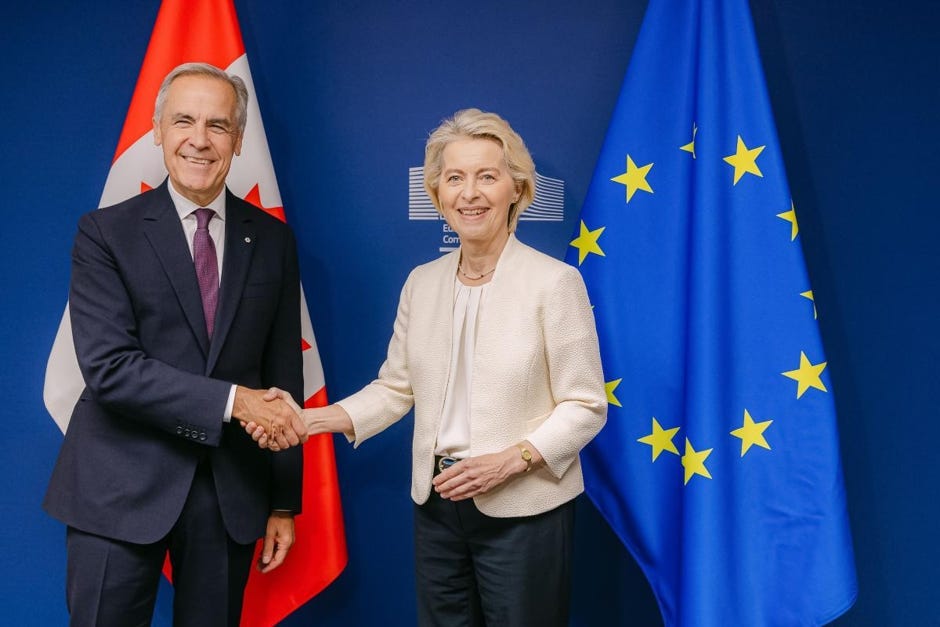
On 16 September, Ursula von der Leyen delivered the EU’s 2026 State of the Union (SOTEU) Address. Here, among other plans, she announced that the door would be open for Canada to assume the role of the EU’s first ever “Associate Member”. There is no precedent for this, and the specifics of this status are still being worked out. However, von der Leyen suggested that the relationship between the EU and Canada will advance from CETA into an alliance for the future, with collaboration planned for intelligent manufacturing, a tech alliance, the integration of defence industrial bases, energy, critical minerals, batteries, AI, quantum, cyber and economic security, as well as a flagship joint project in the Arctic.
“In short, we want to bring the relationship with Canada to the highest level possible.” – Ursula von der Leyen, 16 September 2026.
Canadian Prime Minister Mark Carney has welcomed the initiative, but has reaffirmed that Canada is not seeking to become a full member of the EU. There is currently no legal framework for associate membership, and negotiations within the EU and with Canada must first conclude before Canada can formally assume such status. The details are currently set to be discussed further at the EU-Canada Summit in Montreal on 29-30 October.
There is currently much debate within the EU as to what associate membership is – even the name is uncertain. German Chancellor Friedrich Merz had originally proposed associate membership for Ukraine in May 2026, as an interim status for Ukraine to transition into full membership, and was hesitant to use the same title for the Canadian partnership, according to spokesperson Stefan Kornelius. This original description comprised observer status in EU decision-making bodies, without voting rights, gradual access to EU programmes and mutual assistance in case of future attacks. Kyiv ultimately rejected associate status, instead pushing for full membership. Nevertheless, the EU has used the same label as a long-term prospect for Canada. However, von der Leyen may have acted prematurely by presenting the invitation to Carney at the SOTEU, given that several diplomats from EU member states reported that they were unaware of the announcement. No EU member state has formally rejected the proposal, but debates are ongoing to specify what it entails.
Canada has been actively courting Europe for a closer relationship for some 18 months prior to the announcement at the SOTEU. In March 2025 Carney visited Paris on his first foreign trip as Prime Minister, declaring Canada “the most European of non-European countries”. At the World Economic Forum in January 2026, Carney spoke about the greater need for middle powers to work together as great powers turn tariffs and supply chains into economic weapons. In February, Ottawa signed its agreement to join SAFE at the Munich Security Conference, becoming the first non-European participant. In May, Carney became the first non-European leader to attend a European Political Community summit in Yerevan, Armenia. Germany’s SEFE has also agreed to a preliminary deal to buy Canadian LNG, although greater LNG infrastructure is needed on Canada’s East Coast. In July, Canada chose Germany’s TKMS over South Korea’s Hanwha to build up to 12 submarines, which Carney called the largest defence procurement in Canada’s history.
Associate Membership:
As there is currently no precedent for associate membership, or any mention of it in the EU treaties, there is no existing playbook that Brussels can follow for its implementation. Instead, this legal framework must be negotiated within the bloc. Whatever framework is ultimately established here will likely be a formalisation of several existing initiatives that the EU has with third country partners, and will set the precedent for other associate applicants in the future. Carney also suggests that the set-up should be “open enough that others can join”.
One of the main criticisms is that EU treaty reform may be required, which would be “impossible”, according to an anonymous EU diplomat, given the lack of support. Whilst Brussels has suggested that it can be incorporated without needing treaty reform, there are relevant treaty articles to consider. Since Canada is not seeking full membership, the EU is able to borrow from Article 217 TFEU to establish this legal framework. Article 217 states that “The Union may conclude with one or more third countries or international organisations agreements establishing an association involving reciprocal rights and obligations, common action and special procedure.” The EU has used Article 217 previously for its association agreements with countries such as Türkiye, Ukraine, Moldova and Georgia, although these agreements required extensive alignment with EU law, which Canada would be unlikely to agree to. Full EU membership is closed to Canada under Article 49, which specifies that only a “European State” is able to apply. A genuinely new tier of EU membership, with its own access to EU institutions, would require treaty change, which is exactly what Brussels is hoping to avoid. Instead, it may be more likely that associate membership formalises the highest form of political alignment available to non-European countries, such as Canada, and would represent a framework of mutual bilateral agreements. As a result, Canada may also have a greater chance to be included in the Made in Europe industrial initiative, although this is another hotly debated topic in its own right.
Carney set out his priorities in his speech to the European Parliament, asking for greater cooperation on critical minerals, defence, AI, space and payments, alongside seamless digital trade in non-agricultural goods and services, youth mobility, Erasmus+ membership, involvement with Horizon and the exploration of an integrated market for financial services. Canada already holds existing agreements with the EU in some of these areas, having been associated with part of Horizon Europe since 2024. Several of Carney’s requests come close to the single market’s four freedoms (goods, services, people and capital), which EU leaders have consistently said are indivisible and cannot be cherry-picked, so a more limited agreement is to be expected. One EU diplomat suggested that Canada may be given access to an equivalent of the EU’s Deep and Comprehensive Free Trade Areas deal, which has been offered to partners such as Georgia, Moldova and Ukraine, as there is very little mandate for much more and “member states will not agree on anything else”.
Political Limitations:
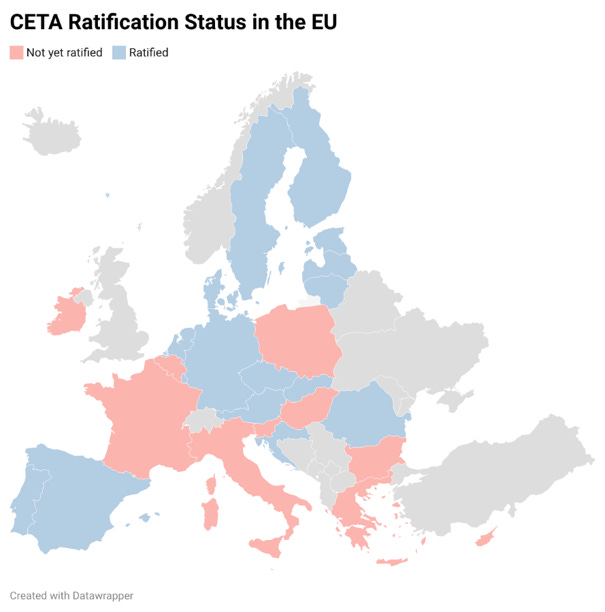
CETA, the existing trade agreement between the EU and Canada, is still to be ratified by 10 EU member states. The fact that the EU has still been unable to secure the unanimous ratification of this trade agreement with Canada after almost a decade does not bode well for the success of the much more ambitious associate membership proposal. The EU member states still to ratify CETA are Belgium, Bulgaria, Cyprus, France, Greece, Hungary, Ireland, Italy, Poland and Slovenia. However, Ireland is moving to ratify the agreement. In June 2026 Ireland passed the Arbitration (Amendment) Act 2026, which addresses the objections raised by its Supreme Court in 2022, clearing the way for Irish ratification. Cyprus’s parliament voted against ratifying CETA in 2020, and the French Senate also voted no in 2024. However, neither has formally notified the EU, so they both legally hold the treaty as “not yet ratified”, rather than “rejected”, meaning that the deal remains provisionally applied allowing much of it to function without complete ratification. This is because the EU considers CETA a mixed agreement, as it covers areas in which the EU has exclusive competence, and areas in which the member states have exclusive competence. Most of CETA’s provisions are within the EU’s exclusive competence, and an estimated 90% of the agreement has been provisionally applied. A deeper association agreement is expected to either act as a layer on top of CETA, or eventually absorb it, as is seen with Chile’s 2002 Association Agreement that is set to be replaced by a modernised framework agreement signed in 2023.
There are also some political limitations on the Canadian side, although none significant enough to suggest that Canada would retreat from the process. Firstly, Ottawa does not have jurisdiction over all of the areas being discussed since the provinces have control over areas such as education, which would challenge the Erasmus+ association, for example. Similarly, labour mobility schemes would also be limited and would be subject to consultation with the provinces, as stated by Jonathan Wilkinson, the Canadian ambassador to the EU. Since 2025, Bill C-202 has also barred Canada’s foreign minister from raising import quotas or cutting tariffs on certain agricultural goods, which helps explain why Carney limited his request for free trade to non-agricultural goods. Wilkinson and Carney have also both ruled out membership as a question of sovereignty, but due to Article 49 restrictions this question is largely academic. The Conservatives have argued that Carney did not have a mandate to seek EU associate membership, and that any potential EU taxes, laws or immigration policy that might follow are red lines. Carney has responded suggesting that the majority of Canadians are in favour of closer ties with Europe, and promised that any final agreement would be debated and ultimately put to a vote in Parliament.
International Reactions:
US President Donald Trump initially reacted with hostility to the prospect of associate EU membership for Canada. He threatened tariffs or to halt trade in some areas with Europe if he determined this to be “a hostile act”. Ultimately, no tariffs came from this – although the reaction highlights the strained relationship between the US and Canada due to their ongoing trade war. On 29 September, US bans came into effect, banning the import of some Canadian alcohol, dairy products and motorcycles. Furthermore, in July the US has also declined to renew the Canada-US-Mexico Agreement and after trade talks collapsed in August, both the US and Canada implemented mutual retaliatory tariffs. The European Commission reacted by stressing that the proposed agreement with Canada is “not against anyone”, although there is little doubt that the deteriorating relationship between Ottawa and Washington caused Canada to look towards Europe.
An interview by European Parliament President Roberta Metsola quickly followed the initial excitement, suggesting that other countries such as Australia or New Zealand could follow the Canadian example and also join as associate members in the future. However, both Australia and New Zealand have been far more restrained. The Australian government instead suggested that its priority was to sign and ratify the EU-Australia trade deal, whilst a New Zealand spokesperson stated that there had been no discussions about associate membership with the EU at all. The UK would be another obvious candidate for the associate member position, with von der Leyen’s invitation to Canada reviving debate about the UK’s own relationship with Europe. UK Prime Minister Andy Burnham has already pledged further steps towards closer ties with the EU, during his meeting with Irish Taoiseach Micheál Martin. Burnham has since gone on to suggest that he would be open to reversing Brexit as it caused “more harm than good”, and that the UK could go “all the way” to rejoin the EU. This challenges Labour’s red lines regarding Brexit as their 2024 manifesto has ruled out the return to the single market or customs union – so a formal realignment such as an associate membership agreement would arguably require a new mandate. Burnham has pledged not to hold an early general election, leaving the election due for 2029 as the earliest feasible date to present a new relationship with the EU to the British electorate.
Conclusion:
For now, the EU associate membership offer to Canada represents the intention to deepen relations, rather than Ottawa immediately assuming a new legal status. Significant debate between EU leaders and institutions is first required to determine the extent to which Canada can align itself with the bloc. The fact that 10 EU member states have yet to ratify CETA almost 10 years after the agreement was signed highlights existing divisions that must first be addressed. Carney has worked to court European leaders since 2025 for such a position, and seems willing to forgo the associate title if it allows Canada to better hedge itself against hostile US trade policy. EU leaders will now meet in Brussels on 15-16 October, prior to the meeting with Canada in Montreal for the EU-Canada summit on 29-30 October. This will be the first opportunity to see how discussions are unfolding, which is significant as the final conditions for Canada will likely set the precedent for future associate member countries. Both the EU and Canada have also been clear that this is not full membership; instead this would be the closest form of formal EU alignment offered to a non-European state that we have seen so far.
If this article was valuable to you, please consider supporting me here or by becoming a paid subscriber. You can also follow this page on Instagram here.
Nice article! Thanks for sharing it.