

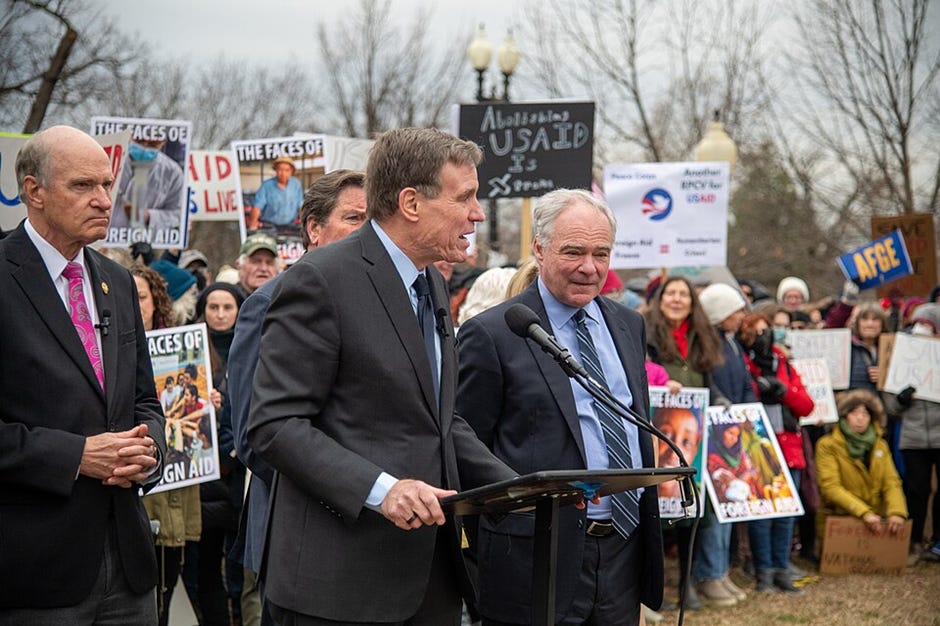
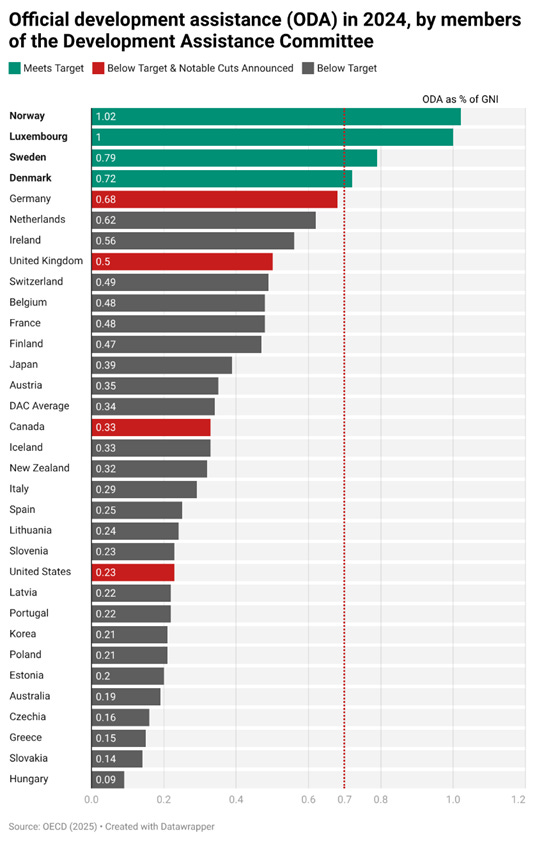
In 1970 the UN General Assembly formally adopted the 0.7% Official Development Assistance (ODA) spending target for economically advantaged countries. This was revised somewhat in later years to 0.7% of Gross National Income (from GDP). However, despite this commitment, only a few countries have ever maintained this 0.7% foreign aid target – and currently only four do. The growing politicisation of foreign aid has increased in recent years following Western cost of living debates, suggesting that less money should be sent abroad. This decision to reduce foreign aid to the developing world has already resulted in severe humanitarian crises which are compounded further with rising energy, fertiliser and food costs following the US-Iran war. This article will examine the existing donor agreements, map out predicted casualties from foreign aid cuts and examine the growing politicisation of foreign aid spending.
A recent article by The Lancet suggested that a mild reduction in ODA could result in the deaths of 9.4 million people (including 2.5 million children under five), whilst a severe defunding scenario could result in as many as 22.6 million deaths (including 5.4 million children under five) by 2030. This follows announcements that several of the top Development Assistance Committee (DAC) are cutting their ODA, bringing their combined all-time high 2023 levels of USD 223.7 billion down to USD 214.6 billion in 2024. Preliminary data for 2025 will be released on 9 April. The severe modelling from The Lancet follows announcements that many of the top donor countries are further reducing their ODA funding. The USAID funding cuts are the most significant here, with an estimated 40% reduction and an 83% reduction of it’s programmes, following the July 2025 announcement. The Lancet study suggests that the closure of USAID will account for 14.1 million deaths (including 4.5 million children under five) by 2030. However, it is important to note that these ODA cuts are widely unsupported in the US, and that US Congress has approved a USD 50 billion foreign aid bill. This is still a 16% reduction from the 2025 level, yet it does help to address some of the most severe concerns despite the overall significant reduction. On 20 March the US announced the creation of a new Bureau aimed at responding to emergencies and humanitarian crises across the world. However, this new bureau is only funded with USD 5.4 billion annually, and will be far more selective in which projects are funded.
Other significant reductions include the UK, who have further reduced their ODA to 0.3% by 2027/28 from 0.5% in 2024 (approximately a £6.5 billion reduction) citing the need for increased defence spending. The UK is an interesting example here, as they are one of the few countries to put their 0.7% ODA commitment into law, rather than simply keeping it as a political obligation – hence a lot of the subsequent controversy following the reduction. The German ODA budget has also been significantly reduced in the last few years, with the money allocated to the BMZ (Federal Ministry for Economic Cooperation and Development) falling from EUR 11.08 billion in 2023 to EUR 10.05 billion in 2026. It is projected that this will fall to EUR 9.3 billion by 2028. Other German ODA ministries have also had their budgets cut considerably.
Germany and other European countries have stated that this shift in spending is due to a refocus on Europe, especially Ukraine. This shift began in 2022 with the Russian invasion of Ukraine where European security was explicitly prioritised. As of 31 December 2025, Germany has made available or earmarked approximately EUR 39 billion for bilateral civilian support and approximately EUR 55 billion for military assistance. In addition to this, Germany has been a key partner in providing political aid with providing security guarantees and support for Ukraine’s political accession to the European Union. Said simply, these are all resources that cannot also be used to support traditional beneficiaries in the Global South. Refugee hosting is also significant, with 4.38 million Ukrainians claiming temporary protection in EU countries. Germany and Poland host the most, with 1,260,230 and 965,990 respectively. The cost of hosting these refugees is included within total ODA figures for several Western countries (e.g. UK, Sweden, Netherlands), therefore inflating headline aid numbers and diverting resources that otherwise would have been sent to developing countries.
Here is a chart presenting the current state of ODA expenditure:
Who is Impacted the Most?
Impacts from this sudden reduction in ODA are widespread across the developing world, with immediate major increases in malnutrition and disease – such as malaria, HIV/AIDS, tuberculosis and cholera reported. There are also less immediate consequences, such as reductions in social programmes and education spending. The single largest loser from these ODA reductions is Ethiopia, which had received USD 4.52 billion in total ODA in 2023 – USD 1.619 billion of which came from the US. As a result, 85% of Ethiopia’s nonprofits have paused operations in 2025, with 5000 health care workers losing their jobs. Cases of malaria have also increased from 900,000 in 2019 to over 7 million in 2024. West and Central Africa in particular is experiencing significant malnutrition and food insecurity. The World Food Programme (WFP) has reported that 55 million people (including 13 million children) there are expected to endure crisis-levels of hunger during the June-August 2026 season. In Nigeria, the WFP will only be able to serve 72,000 people in February – a huge reduction from the 1.3 million people assisted during 2025. Sudan is quickly spiralling into the world’s worst humanitarian disaster due to the ongoing war and this cut in foreign aid assistance. 30 million people are now facing a humanitarian emergency here. Other countries that were dependent on PEPFAR (President’s Emergency Plan for AIDS Relief) funding have also been let down. Initial disruptions resulted in healthcare workers being dismissed, projects being cancelled and the potential reversal of key progress made in the fight against HIV/AIDS. It is now proposed that the funding for PEPFAR is to be phased out, with the idea that the majority of recipient countries become self-reliant by 2030. In terms of aid lost as an equivalent to 2023 GNI levels, Micronesia is set to suffer the most losing 11.2%, followed by Somalia at 6.1%, Afghanistan at 5% and the Central African Republic at 3.7%. The largest share of these cuts is from the US reduction, although the European re-allocation of aid is also noteworthy.
It had initially been expected that many of the worst affected countries would quickly re-allocate their resources to meet these humanitarian demands. However, this has not meaningfully materialised for many of those affected. In Ethiopia’s case, the government had planned to better utilise domestic resources, Public-Private Partnerships and alternative donor engagement. Despite this, many are left without aid and refugees are facing increasing food insecurity following the WFP’s critical funding shortage. The situation is similar in Somalia, where 6.7 million people now face an escalating hunger crisis following aid cuts, conflict and a severe drought. The EU has announced an additional EUR 63 million relief package, whilst the US has resumed aid delivery following a resolution to the suspension in January 2026.
Naturally, these predictions do not include the compounding pressure of the Iran War. Trade through the Strait of Hormuz remains collapsed, which has consequently resulted in surging energy and fertiliser costs as shipping remains disrupted. This restricts the trade of 27% of the world’s oil, 20% of global liquified natural gases and 20-30% of global fertiliser exports. The prices of urea, for example, have increased over 70% since the start of the war, causing concern that many farmers will not have sufficient access to fertilisers in the growing season. Even if the war ended immediately, it could take months/years for energy and fertiliser prices to drop to normal levels. As a result, it has been predicted that up to 323 million people will experience food insecurity if the crisis continues. The World Bank suggests that the conflict will be directly responsible for 45 million additional people who are pushed into acute hunger by mid-2026.
The Politicisation of Foreign Aid
Unfortunately, the decision to provide foreign aid is often reduced to the idea that money is simply given away to other countries. This idea is especially common among more populist political parties, who often run on pledges to reduce ODA spending further and invest the difference domestically. As an example, the UK’s Reform party running on a plan to cap ODA at £1 billion(or about 0.03% of GDP), a significant reduction from the approximate £9 billion spent today. A 2025 study found that far-right governments reduced spending to international organisations by almost 30%. Even if these parties do not achieve political office, their public criticism of ODA spending may contribute to its reduction when strategic objectives demand budget change.
The issue here is that this minimises the positive benefits of foreign aid spending, such as stabilising neighbouring states and developing trade/cultural relationships, preventing large-scale refugee flows and establishing soft power internationally. The security concerns associated with instable neighbouring states are often overlooked with aid cuts and may prove more costly in the long run, should a real crisis emerge. An important caveat is also that if the decision is made to reduce ODA spending, then it is best done in a controlled reduction over time, rather than an abrupt stop all at once. This was seen when the US closed USAID in 2025 and overwhelmed many recipient countries at once, rather than introduce a more reasonable long-term plan to ensure stability. It is also increasingly common for ODA to come with political conditions. As a result, the distinction between geopolitical conditionality (such as South Africa’s ICJ Stance) and ideological conditionality (DEI, Gender Identity etc.) is becoming increasingly blurred for the Trump Administration.
If this article was valuable to you, please consider supporting me here or by becoming a paid subscriber. You can also follow this page on Instagram here.
The Promise Nobody Kept
1970. Rich countries made a promise.
Spend 0.7% of your income helping poorer ones. Not even one percent. Just 0.7.
Today only four countries do it.
---
The Lancet ran the numbers. Moderate cuts — 9.4 million deaths by 2030. Severe cuts — 22.6 million. Including children under five.
Not from war. From empty clinics. Diseases that cost $2 to treat.
USAID took the biggest hit. 83% of programmes gone. 14.1 million of those projected deaths sit directly on that closure. Congress passed a replacement bill — still 16% less than before. The new emergency bureau gets $5.4 billion and picks its battles carefully.
The gap between what existed and what replaced it is enormous.
---
Aid gets sold as charity. Money thrown into a hole.
It isn't.
Stable neighbours mean fewer refugees at your border. Aid relationships become trade relationships. Soft power is real — just slow. Easy to cut. The bill arrives later, louder, more expensive.
Cutting abruptly — like USAID — doesn't save money. It just creates the next crisis early.
---
0.7% was never a generous ask.
Most never managed it. Now we're cutting what little existed.
The deaths won't make headlines. They'll just quietly happen in places most people won't look.