

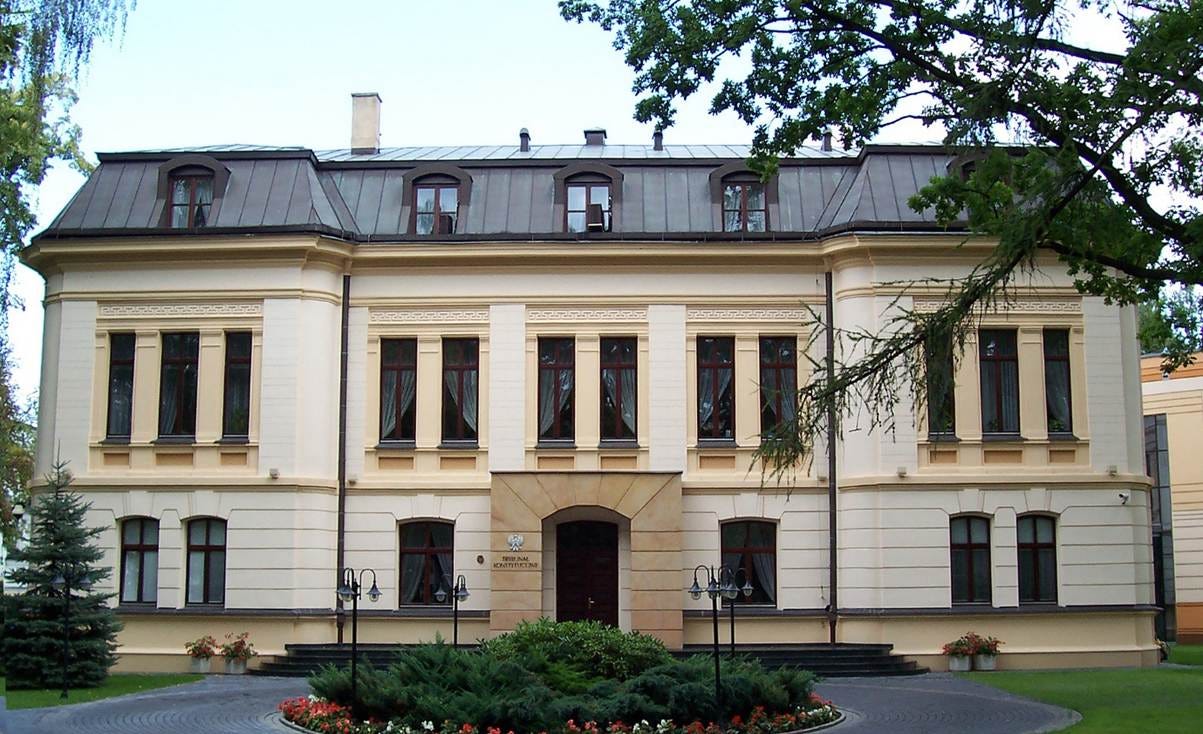

Late on 30 October, Polish Prime Minister Donald Tusk’s government, a coalition led by the Civic Coalition (KO), moved to forcefully end a political standoff that has effectively paralysed the Polish judicial system. Seven of the judges elected to the Constitutional Tribunal (TK) by the Polish Parliament, the Sejm, earlier this year entered the building whilst being escorted by the State Protection Service (SOP), which is a subordinate of Tusk’s interior minister. The Law and Justice (PiS)-aligned Polish President Karol Nawrocki had previously refused to swear in several of these judges, citing doubts over their election by the Sejm. Just after 18:00 that evening, the TK website announced that judge Anna Korwin-Piotrowska had taken control of the TK as de facto leader, and that the TK’s president Bogdan Święczkowski, together with the vice-president Bartłomiej Sochański, had been suspended for one month by Korwin-Piotrowska, citing Article 130 of the Law on the System of Common Courts. Korwin-Piotrowska had also called the police to the TK, citing the safety of the judges present and public order, and riot police set up around the grounds. Crowds of protesters and senior PiS figures surrounded the TK building in response.
“Restoring the rule of law is our duty. After years of lawlessness, it is a difficult process, sometimes painful and requires decisive action. There is no other way” – Donald Tusk, via X.
The TK X account, still controlled by Święczkowski, called the takeover unlawful, asserted the roles of Święczkowski and Sochański, and warned that everyone involved was “committing the crime of a coup d’état”. President Nawrocki, who at the time was travelling to Senegal for a diplomatic visit, ordered his plane to turn around and return to Warsaw – “at such a moment, the President must be in Poland”. Nawrocki was able to enter the TK compound, and clashed verbally and physically with the judges involved. Afterwards, he announced that a series of meetings would take place on 31 October to discuss the crisis. The Left and Tusk’s KO refused to attend the meetings, with KO suggesting that the President’s only task is to accept the oaths of the new judges. PiS leader Jarosław Kaczyński accused Tusk of turning Poland into a police state, whilst KO figures framed the same event as ending PiS influence over the TK and returning Poland to an independent rule of law and constitutional order. Jan Grabiec, head of Tusk’s chancellery, suggested that the real coups were President Andrzej Duda’s blocking of judges’ oaths in 2015, and the recent actions of Nawrocki.
International reactions have varied, with the US Ambassador to Poland Tom Rose stating “The events unfolding tonight at Poland’s Constitutional Tribunal are very serious indeed. We appear to be witnessing an unprecedented confrontation over the government’s use of state power and the independence and authority of a constitutional institution.” European right-wing figures such as Nigel Farage, George Simion, Balázs Orbán, Marine Le Pen and Geert Wilders all spoke against the move, suggesting that Tusk is damaging Polish democracy or undertaking a judicial coup. Poland’s foreign minister Radosław Sikorski has responded, asking commentators such as Le Pen not to interfere in Polish politics. Former Russian president Dmitry Medvedev has also accused Tusk of a “constitutional coup”, whilst Tusk has suggested that pro-Russian groups could be exploiting the situation in Poland to support his opposition online. Most notably, the European Commission has lent support to Tusk, reiterating that the Sejm must have the right to appoint new judges so that it can properly function in accordance with the Polish constitution and the case law of the Court of Justice of the EU. The EU has vested interests here, given the extent of the previous Article 7 procedure against Poland, and the success of Tusk’s pro-EU policies. The International Commission of Jurists criticised both sides, suggesting that the takeover “contravenes international standards on the independence of the judiciary”, whilst maintaining that Nawrocki’s refusal to swear in the judges also “violates international standards”. Even prominent critics of PiS, such as Marcin Matczak or the Helsinki Foundation for Human Rights, have conceded that there is no legal basis for suspending Święczkowski and Sochański.
Nawrocki’s talks on 31 October didn’t produce a breakthrough. However, five parties (Deputy Prime Minister Władysław Kosiniak-Kamysz’s PSL, Poland 2050, Razem, Konfederacja and Rozwój Plus) suggested a constitutional reset, in which all 15 judges would be replaced to end the crisis. This would require an amendment to the Polish constitution, which in turn requires a two-thirds majority vote in the Sejm and an absolute majority in the Senate – which is implausible since both KO and PiS are currently opposed to the suggestion. Tusk maintains that there can be no compromise, and that no politician may enter the court and give orders to the judges – even the president. Nawrocki’s office has said that it will report Korwin-Piotrowska and two other judges to the prosecutor’s office for violating the president’s inviolability. On 3 November, the eight new judges held a general assembly broadcast, in which they declared themselves quorate by excluding three PiS-era judges, adopted a draft 2027 budget and drew lots for the disciplinary panels that will rule on the suspensions. Święczkowski, the suspended TK president, dismissed the meeting as a social gathering. The same day, at a meeting of the National Security Council, Nawrocki described Tusk’s actions as a crime against the constitution, with Tusk inviting Nawrocki to a one-to-one meeting to lower tensions. The Polish public appear split on the issue, with polling suggesting that 40% named Korwin-Piotrowska as head of the TK, whilst 24% named Święczkowski and a third were unsure.
Background:
How did we get here? The events on 30 October mark Tusk’s attempt to forcefully end the long-standing judicial dispute with PiS. The dispute began in 2015, when the outgoing Civic Platform (PO) majority, using a law it had passed that June, elected five TK judges, two of whom were assigned to seats that would only fall vacant after the next Sejm had convened. After PiS won the election later that month, its new majority in the Sejm passed resolutions to declare the elections void, and President Andrzej Duda had refused to swear in any of the judges. The Sejm then chose alternative candidates on 2 December, and Duda swore in four of them hours later on 3 December and the fifth judge on 9 December, since the previous judge had sat until 8 December. However, on 3 December, hours after the oaths were accepted, the TK ruled that three of the five original appointments were constitutional, whilst two were not, and that Duda must swear in the properly elected judges, rather than the PiS alternatives. As none of the five PO appointments were sworn in by Duda, their appointment was disputed by the new PiS government, which instituted reforms to ensure that all five of its nominees sat in the TK. In January 2016, the TK declined to review the Sejm’s resolutions on the judges, suggesting that this fell outside of its jurisdiction. The government read this as confirmation that its five judges had been lawfully elected. However, in March 2016, the TK struck down the first law from PiS that sought to reshape the court, which the government treated as an advisory, non-binding opinion, rather than a legal judgment. The Polish executive and legislative branches refused to accept the ruling, which in turn deepened the constitutional crisis. In July 2017, Duda broke publicly with PiS leader Jarosław Kaczyński by vetoing two of three judicial bills, on the Supreme Court and the National Council of the Judiciary (KRS), after protests had sparked in over a hundred cities across Poland. However, Duda let the ordinary-courts bill through, and later signed PiS’s amended versions of his replacement drafts, hours after the European Commission launched Article 7(1) TEU proceedings against Poland.
The ordinary-courts bill granted the Minister for Justice, Zbigniew Ziobro, sweeping authority over the country’s judicial system, and allowed the minister to dismiss court presidents and vice-presidents at will over a six-month period. Between August 2017 and February 2018, the minister unilaterally dismissed 158 court presidents and vice-presidents across Polish courts, often by fax. In November 2019, the Court of Justice of the EU (CJEU) ruled that parts of the 2017 ordinary-courts law were contrary to EU law as it was found to undermine judicial independence, facilitate discrimination between male and female judges as they were set different retirement ages, and it let the Justice Minister decide which judges could serve beyond these retirement limits. In 2021, the European Court of Human Rights (ECHR) ruled that the premature termination of two of these judges’ terms without a judicial review violated their right of access to a court. Furthermore, the ECHR also ruled that a TK bench including one of PiS’s disputed judges was not a “tribunal established by law”. In response, the TK issued a ruling challenging the primacy of EU law, suggesting that parts of the EU treaties were incompatible with the Polish constitution and it declared the European Convention’s fair-trial guarantee inapplicable to its own proceedings. In turn, the European Commission launched infringement proceedings against Poland in December 2021, whilst billions of euros in recovery funds remained frozen over the PiS government’s disciplinary regime for judges, for which the CJEU had ordered Poland to pay €1m a day until it complied.
Tusk returned to power in December 2023 at the head of a coalition, marking the beginning of the end for PiS dominance over the judicial system. Brussels moved quickly to support Tusk’s government, unblocking €137 billion in frozen EU funds for Poland in February 2024, and closing the Article 7 procedure against Poland in May, even though the dispute with the TK and the status of over 2,000 judges that the PiS-era KRS had recommended were still unresolved.
Duda and his presidential veto were now the primary barrier for Tusk’s coalition, blocking them from reforming the judiciary and the TK specifically. Unable to legislate past this veto, Tusk’s coalition increasingly began acting without new laws and refused to recognise the TK and stopped publishing its rulings – the same tactic that PiS used in 2016. When the Sejm passed bills to remove the three contested PiS-era judges, Duda refused to sign the bills and instead referred them to the TK itself, still heavily politicised and stacked with PiS appointments. Because the coalition did not recognise the TK’s legitimacy, it refused to fill seats and left them empty as terms expired – leaving only nine of the 15 seats filled by the end of 2025. Any hope of a clear legislative solution disappeared once Nawrocki won the presidential election in June 2025, with 50.9% of the vote; within a year Nawrocki had vetoed more bills than any of his predecessors had in their entire terms. In December 2025, the CJEU ruled that the TK was not an independent and impartial tribunal established by law, citing the 2015 appointments and the irregular selection of the TK’s president in 2016.
In March 2026, the Sejm elected six judges, two of whom were sworn in by Nawrocki – who argued that only two seats had fallen vacant since he took office. As a result, the other four took their oaths before a notary in the Sejm, but the TK president Święczkowski refused to admit them, despite an interim measure from the ECHR which ordered that they be allowed to sit. In May, the TK ruled that the president was under no obligation to swear in judges elected by the Sejm. Two more judges followed: Sławomir Patyra whom was sworn in by Nawrocki, but refused to sit whilst his colleagues were excluded, and Maciej Berek – a former minister whom Tusk called his right-hand man – who took his oath in the Sejm on 14 October without the president. On 13 October, the Venice Commission, an advisory body to the Council of Europe on constitutional law, urged Nawrocki to swear in the remaining judges, whilst Nawrocki’s spokesman stressed that the Venice Commission’s opinions are strictly advisory and not legally binding.
What now?
For now, the TK will largely decide what happens next. Korwin-Piotrowska has called another general assembly for 10 November to revise the TK’s internal rules, and on 17 November the judges will convene to consider seven motions from the prosecutors to lift the immunity of Święczkowski and Sochański. Six motions concern Święczkowski, covering his handling of Pegasus surveillance material, the purchase of the Hermes system as national prosecutor, as well as exceeding his powers and failing to fulfil his duties by blocking TK judges from carrying out their functions. One motion even seeks consent to detain him and ask a court to remand him in custody. If the assembly agrees, the court asked to remand Święczkowski would first have to decide whether to accept the TK’s consent as valid, in effect ruling on whether Korwin-Piotrowska’s majority is the lawful TK. The Supreme Court has so far not offered Święczkowski or Sochański a way back: it declined jurisdiction over their complaints against the suspension, and passed them back to the TK. This suspension will lapse at the end of November, unless the disciplinary panels suspend them formally.
The government is acting as if the matter is closed, with Tusk stating on 5 November that “from my point of view, the legal problem is solved”. The one-to-one meeting offered to Nawrocki has not taken place, after Nawrocki’s chancellery made it conditional on the police cordons leaving the TK’s grounds and the “legal judges” entering it. Meanwhile, the PSL has turned its constitutional reset proposal into a draft amendment under which the National Assembly, on a motion from the KRS, could declare the TK permanently unable to function by a three-fifths vote, ending every judge’s term and then elect 15 new ones on staggered terms from candidates approved in advance by the president. Konfederacja, Rozwój Plus and Poland 2050 have agreed to work on it, but KO and the Left have both refused, meaning that the amendment cannot reach the two-thirds majority needed in the Sejm.
Former prime minister Mateusz Morawiecki’s Rozwój Plus is still short of 46 the signatures needed to launch a constructive vote of no confidence against Tusk’s government. Additionally, on 6 November, the PiS motion to dismiss the interior minister, Marcin Kierwiński, partly regarding the police’s involvement at the TK, failed by 235 votes to 212. The PSL’s 32 MPs voted with the coalition, and as a constructive vote needs 231 votes, the PSL holds the balance. Renewed protests around the TK building were called off at Kaczyński’s request for the national mourning period declared by Nawrocki following the tragic mass shooting in in Kraków on 7 November. On 11 November, Nawrocki will join the Independence March, whose organisers are expecting half a million or more attendees and say that they will protest against the “forceful takeover of the constitutional body”, although the march will keep its usual route, away from the TK building. Whatever happens, the conclusion of the constitutional dispute will likely feed into the results of the parliamentary election due in autumn 2027. Polling by CBOS taken on 2-4 November, found that declared 2027 election turnout increased 3.7 points, to 77.7%, suggesting that the events at the TK are linked to the increase.
If this article was valuable to you, please consider supporting me here or by becoming a paid subscriber. You can also follow this page on Instagram here.